

Parvovirus B19 (Slapped Cheek Syndrome, Fifth Disease or Erythema Infectiosum)
Parvovirus B19 (Slapped Cheek Syndrome, Fifth Disease or Erythema Infectiosum)
Parvovirus B19 causes slapped cheek syndrome which is usually a mild self-limiting viral illness and is very common in childhood. Infection is more likely after contact with an infectious person in a household setting rather than an occupational (school) setting. Simple hygiene measures including careful hand washing provide the most effective method of prevention and control of this viral disease. There is no vaccine available.
Infection due to Parvovirus B19 can affect all age groups but is more common in children than adults. About 60% of adults have been infected at some point during their lives and cannot be re-infected. In rare cases infection during pregnancy can be harmful to the developing baby. Most pregnant women, especially women who work with children, are already immune to parvovirus and therefore do not become infected. Also in rare cases, infection in people with chronic red blood cell disorders (e.g. sickle-cell disease or spherocytosis) or whose immune system is significantly weakened, may result in severe anaemia requiring treatment.
Parvovirus B19 only infects humans and cannot be picked up from animals. It spreads from person-to-person. Parvovirus B19 virus has a natural cycle; every three to five years, an increase in the number of infections occurs. It is a seasonal disease, with increases in infection in late spring and early summer.
Parvovirus B19 Epidemiological Data
Parvovirus B19 is not a notifiable disease in Ireland, therefore laboratory test data from the National Virus Reference Laboratory (NVRL) is displayed.
In 2024, Ireland, like other countries, has seen an increase in positive laboratory tests for Parvovirus B19, following low levels seen during the pandemic years.
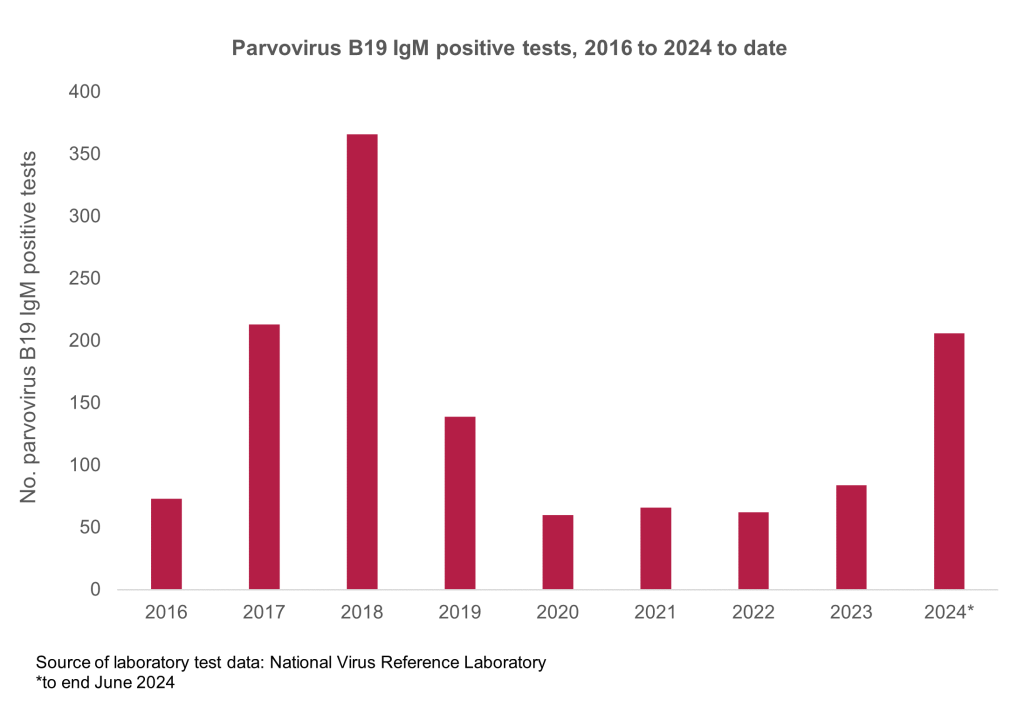
Parvovirus B19 in Ireland, 2024
| 411 | The number of positive Parvovirus B19 IgM tests January 2024 to end December 2024 |
| 5.9% | The percentage Parvovirus B19 IgM test positivity January 2024 to end December 2024 |
Last updated: 20 May 2025
What is parvovirus B19 (Parvovirus)?
Parvovirus B19 is a common childhood viral illness. It is a mild illness and can affect all age groups but is more common in children than adults. Approximately 60% of adults have been infected at some point and cannot be re-infected. In rare cases infection during pregnancy can be harmful to the developing baby. Parvovirus B19 only infects humans and cannot be picked up from animals. It spreads from person-to-person. Parvovirus B19 is not a notifiable disease in Ireland.
Human parvovirus B19 infection is also called:
- Slapped cheek syndrome
- Fifth disease
- Erythema infectiosum
What are the symptoms of parvovirus B19?
20-30% of people infected with parvovirus B19 get no symptoms. If symptoms do occur they are usually mild and may include:
- fever
- runny nose
- headache
- rash on the face and/or body.
Symptoms can take between 4 to 20 days to appear after infection, but usually 13 to 18 days.
Symptoms vary depending on whether you get the infection as a child or an adult.
Children:
The red rash on the face called “slapped cheek” rash is the most obvious sign of parvovirus B19. This rash is more common in children than in adults.
A second rash may appear a few days later on the chest, back, buttocks, or arms and legs. The rash may be itchy, especially on the soles of the feet. It usually goes away in seven to 10 days, but it can come and go for several weeks. As it starts to go away, it may look lacy.
Adults:
Adults who are infected with parvovirus B19 may have no symptoms at all, or may develop a rash with joint pain or swelling, or both. It is usually the small joints of both hands that are affected however sometimes ankles, knees and wrists are also affected. The joint symptoms usually go in a week or two, but can last longer.
How can you get parvovirus B19?
Parvovirus B19 can be picked up through close personal contact with someone who has the infection. People infected with parvovirus B19 spread the virus through the air when they cough or sneeze. People nearby may breathe in the virus from an infected person’s cough or sneeze and get infected. Rarely, it can be picked up through contact with the blood or urine of someone who has parvovirus B19 infection. A pregnant woman who is infected with parvovirus B19 can pass the virus to her baby.
A person is most contagious when it seems like they have “just a fever and/or cold” and before they get the rash or joint pain and swelling. People are very infectious for 7 days before they develop a rash. After they get the rash they are not likely to be contagious so then it is usually safe for them to go back to school or work. People with weakened immune systems may be contagious for a longer amount of time; for instance people experiencing cancer treatment, organ transplant or HIV infection etc.
Who can get parvovirus B19?
Anyone who has never had the infection can get sick from parvovirus B19.
Children: the infection is most common in children aged between 5 and 14 years
Adults: approximately 40% of adults do not get the infection during childhood and can still get the infection.
Who are at higher risk of complications from a parvovirus B19 infection?
Parvovirus B19 infection is usually mild for children and adults who are otherwise healthy. For people at higher risk of complications, it can cause serious health complications, such as chronic anaemia that requires medical treatment. People with a higher risk of infection include:
- Pregnant women
- Patients with weakened immune systems from an organ transplant, cancer treatment or HIV infection
- People who have sickle cell disease or similar problems producing red blood cells.
What time of the year are you most at risk from parvovirus B19?
Parvovirus B19 circulates in the community all year round, with increases in the numbers of people infected in late spring/early summer. Parvovirus B19 seems to follow a pattern, with increases in the number of people infected every 3-5 years.
How do you prevent getting infected?
There is no vaccine or medicine that can prevent you getting parvovirus B19 infection. You can reduce the chance of getting infected or infecting others by:
- washing your hands often with soap and water
- covering your mouth and nose when you cough or sneeze
- not touching your eyes, nose, or mouth
- avoiding close contact with people who are sick
- staying home when you are sick.
How is parvovirus B19 diagnosed?
- Healthcare professionals can often diagnose parvovirus B19 infection just by seeing “slapped cheek” rash on a patient’s face.
- A blood test can show if you are immune to parvovirus B19 infection or if you were recently infected. This is not a routine test but can be performed in special circumstances. The blood test may be particularly helpful for pregnant women who may have been exposed to parvovirus B19 and are suspected to be infected. Talk to your healthcare provider.
What is the treatment for parvovirus B19?
Parvovirus B19 is usually mild and will go away on its own.
- Children and adults who are otherwise healthy usually recover completely. Treatment usually involves relieving symptoms, such as fever, itching, and joint pain and swelling.
- People who are at higher risk of complications from parvovirus B19 (see above) should see their doctor for advice.
What if I am pregnant?
Usually there are no serious complications for a pregnant woman or her baby following exposure to a person with parvovirus B19 infection. Most pregnant women will be immune to getting the disease and these women and their babies are protected from infection and illness.
For women who are not immune a small number may become infected and the infection usually causes a mild illness. For a small number of women who develop infection, the infection may pass to the baby. In most instances the baby gets a mild illness. On rare occasions, infection in the baby before the pregnancy has reached 20 weeks may cause anaemia which may need treatment. Rarely infection in early pregnancy has been associated with miscarriage.
Pregnant women who have had close contact with an infected person either at home, in the community, or at work, should inform their doctor. If parvovirus B19 is confirmed, the doctor/midwife/obstetrician may want to monitor the baby by ultrasound. Simple hygiene measures including thorough hand washing and avoiding sharing eating and drinking utensils provide the most effective method of prevention and control of this viral disease.
Occupational risk
People are very infectious for the 7 days before they develop a rash. After the rash appears, they are not likely to infect anyone else so it is usually safe for them to go back to school or work. Pregnant women who work around children have a slightly higher risk of getting the infection, especially in the first years of their career as they might not have had the infection before. Usually pregnant women who have young children at home are most at risk of getting an infection. There is generally no need for pregnant women to stay at home from work or school when parvovirus is circulating in the community, unless there is a medical reason, as advised by their doctor. If an outbreak occurs in a pregnant woman’s workplace, risk assessment will be undertaken to see if there is a need for her to stay at home from work. If staying at home from work is advised, it is generally not needed after 22 weeks of pregnancy, unless there is a medical reason for staying at home.
Additional guidance:
Ireland: HPSC: http://www.hpsc.ie/a-z/other/parvovirus/ HSE: https://www2.hse.ie/conditions/parvovirus-pregnancy/
United Kingdom: https://www.gov.uk/guidance/parvovirus-b19
United States of America: https://www.cdc.gov/parvovirusb19/fifth-disease.html
Last updated: 12 July 2024
Guidance
See Clinical Practice Statement: Parvovirus B19 in pregnancy from the Clinical Guideline Programme for Maternity and Gynaecology.
Algorithm for Testing and Management of Pregnant Women (< 22 weeks gestation) who are contacts exposed to Parvovirus B19: Healthcare Setting
04, Sep 2024
369.13 KB
Algorithm for Testing and Management of Pregnant Women (< 22 weeks gestation) who are contacts exposed to Parvovirus B19: Non-Healthcare Setting
04, Sep 2024
375.97 KB
Parvovirus B19 (B19) Infection during pregnancy - Patient Information Leaflet
04, Sep 2024
243.44 KB
Occupational Health advice for non-immune pregnant women who are contacts of one or more highly suspected or confirmed case of parvovirus B19 infection (B19)
24, Jul 2024
232.44 KB
Information, Data and Reports for Parvovirus B19 (Slapped Cheek Syndrome, Fifth Disease or Erythema Infectiosum)

Ireland’s specialist service for the surveillance of communicable diseases.