

Antenatal HIV Testing in Ireland
Background
The transmission of HIV from a HIV positive mother to her child during pregnancy, labour, delivery or breastfeeding is called vertical transmission. Diagnosis of HIV in pregnancy allows for effective interventions to be implemented and has dramatically reduced the risk of HIV transmission from mother-to-child during pregnancy, delivery and in the postnatal period to less than 1% (1, 2).
Objectives of Antenatal HIV testing
The objectives of HIV antenatal screening are to identify women who are HIV positive so they can be offered immediate treatment for their own clinical benefit, to prevent transmission of HIV to their child and to prevent transmission of HIV to their sexual partners.
Introduction of Voluntary Antenatal Testing in Ireland
A national voluntary programme of HIV antenatal screening has been in place in Ireland since 1999. As part of this programme, it is recommended that HIV testing be offered to all women who attend for antenatal services. The test is offered during the first trimester so women living with HIV are identified and can begin treatment early to maximise clinical benefit for both mother and child. Aggregate anonymised data on uptake of testing and the numbers of HIV diagnoses in pregnancy are requested annually from all maternity hospitals/units and collated nationally by HPSC.
The latest annual report on HIV Antenatal Screening in Ireland can be found here.
Antenatal HIV testing in Ireland, 2024
In 2024:
- Aggregate anonymised data on HIV antenatal testing in public patients was provided by 19 of 19 maternity hospitals/units. 13 out of 19 hospitals provided information on private patients.
- The national reported uptake of HIV antenatal testing was 100%
- The total positivity rate of HIV among pregnant women was 0.11%
- The positivity rate of first-time HIV among pregnant women was 0.03%
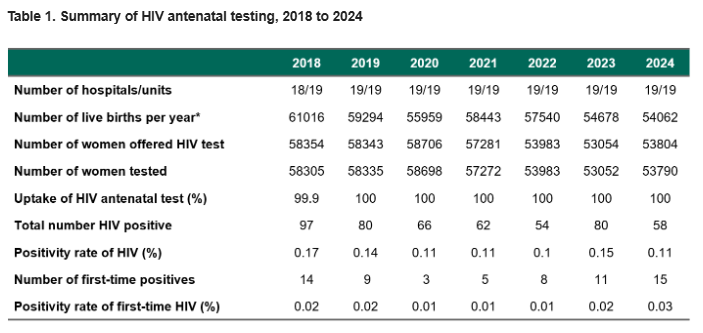
- Majority (74%) of positive HIV antenatal tests among pregnant women in 2024 were in women already known to be living with HIV (i.e. known diagnoses*)
- Total positivity rate decreased compared to 2023.
- Positivity rate of first-time HIV among pregnant women increased slightly compared to 2023 but overall remains low.
*The number of known HIV diagnoses was calculated by subtracting the number of first-time HIV diagnoses from the total number of HIV diagnoses.
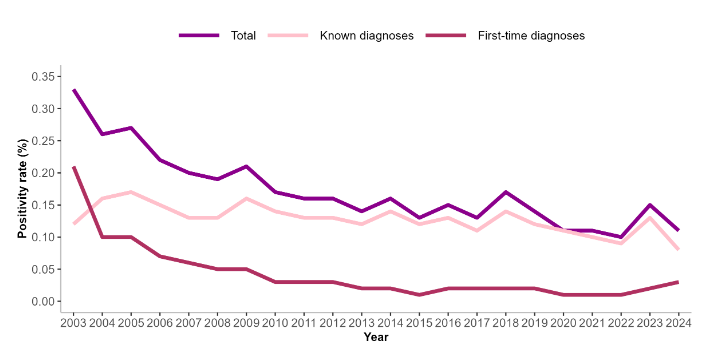
Figure 1. Trend in positivity rates of HIV in pregnant women, 2003 to 2024
Limitations
Limitations of the data collected include
- Data on private patients from some hospitals not available
- Lack of information systems in some hospitals requiring manual data retrieval
- Use of aggregate data which limits the ability to analyse data by different parameters
References
- Townsend CL, Byrne L, Cortina-Borja M, Thorne C, de Ruiter A, Lyall H, Taylor GP, Peckham CS, Tookey PA. Earlier initiation of ART and further decline in mother-to-child HIV transmission rates, 2000-2011.AIDS. 2014 Apr 24;28(7):1049-57.
- Helen Peters, Kate Francis, Rebecca Sconza, Anna Horn, Catherine S. Peckham, Pat A. Tookey, Claire Thorne; UK Mother-to-Child HIV Transmission Rates Continue to Decline: 2012–2014, Clinical Infectious Diseases, Volume 64, Issue 4, 15 February 2017, Pages 527–528
Last updated: 28 November 2025
Information, Data and Reports for
-
HIV Infection in Ireland
- Factsheets
- HIV: People who inject drugs
-
HIV Data and Reports
- HIV data and reports, 2023
- HIV data and reports, 2022
- 2021 Reports
- 2020 Reports
- HIV & AIDS Surveillance Reports - 2019
- HIV & AIDS Surveillance Reports - 2018
- HIV & AIDS Surveillance Reports - 2017
- HIV & AIDS Surveillance Reports - 2016
- HIV & AIDS Surveillance Reports - 2015
- HIV & AIDS Surveillance Reports - 2014
- HIV Reports: Quality and Completeness
- HIV Drug Resistance
- HIV Treatment and PrEP
- HIV Recent Infection Assay
- HIV Testing
- Antenatal HIV Testing in Ireland
- HIV Guidance
- Surveillance protocol
- Case Definition
- Journal Articles
- Links to further information on HIV and AIDS
Ireland’s specialist service for the surveillance of communicable diseases.